Showing posts with label Phenotype. Show all posts

Friday, April 30, 2010

Reliably Replicating Phenotype


I will preface this journal entry with an admission: I understand very little about equine genetics.

I do comprehend the difference between genotype (the inherited genetic information) and phenotype (the environmentally influenced observable results of how inherited genes express themselves morphologically, physiologically and behaviorally).

Genetically, the Sorraia and the Sorraia Mustang horses do not have an unadulterated lineage that can, definitively lay claim to them being a "pure breed", and, to my knowledge, no one involved with the preservation of the Sorraia horses has made such claims. These horses do not represent a "breed", though they are often referred to as such. Some researchers understand the Sorraia to reflect an ancestral "form" of primitive equine, most likely the Southern Iberian variant of the Tarpan (Equus ferus).


The Tarpan is thought to have dwelled in as diverse regions as France, Iberia and Russia and likely many others with phenotypical variations relating to the environments they existed within--thus we hear of the "Forest Tarpan" and the "Steppe Tarpan".

The last remaining Tarpan died in 1876.

Some descriptions tell of variants that had convex profiles, others had concave...some had upright manes, others had falling manes. Some were a bit shorter, others a bit taller--but they all were fine limbed with well articulated tapered heads and all were considered "mouse dun" in colour, with hues ranging from very light (almost white) to very dark (almost black) and as such they had prominent dorsal stripes and often stripes on their legs and shoulders and bi-coloured manes and tails.

My understanding is the Tarpan represented a genetic subspecies of wild equine and expressed variations in phenotype relating to which ever environment it adapted itself to and it was distinctly different than the wild Asiatic horse (Przewalski's Horse). In prehistoric cave paintings we find not only images remarkably similar to Przewalski's Horse, but also to the Tarpan in both its variant forms, one looking more like the Celtic pony and the other looking much more like the Sorraia. Incidentally, the medieval Iberians described striped wild horses of like characteristics that lived in their region and they called them Zebros.

Here at the Ravenseyrie Sorraia Mustang Preserve, our desire has been to assist in the preservation of the genetically bottlenecked Sorraia--the indigenous wild horse of southern Spain and Portugal--(dare I say the Iberian Tarpan?) by assembling a small group of North American mustang mares from various Iberian-influenced strains that each possess Sorraia characteristics and crossing them with a purebred Sorraia to enhance genetic variability.

Our foundation mares are:

--Ciente, a "purebred" Kiger Mustang
--Bella, a "purebred" Spanish Mustang
--Belina, part Spanish Mustang/part feral Appaloosa Mustang pony
--Zorita, part Sorraia/part Sulphur Mustang

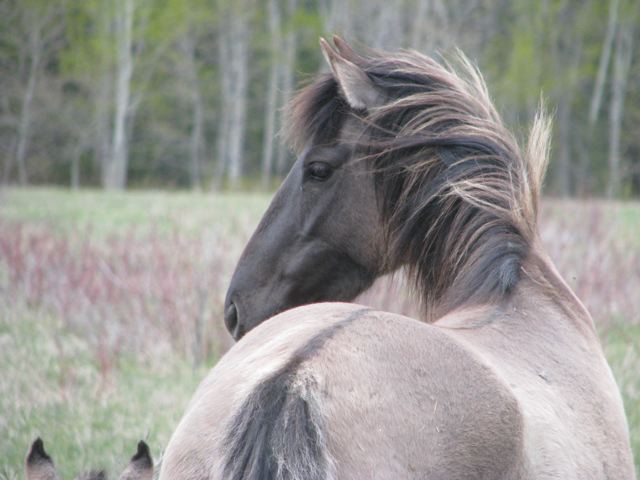
Our Sorraia stallion, Altamiro and his harem of Sorraia Mustang mares are this year presenting us with their third "foal crop" which so far shows such remarkable uniformity among them and the first two years' offerings, one cannot help but conceive that the phenotype of the Iberian Tarpan is alive and well--testifying to the strength of the ancestral genetics that remain in present day horses and were just waiting for the right environment to consolidate the way this particular phenotypical expression manifests itself.

For me, this validates several assumptions regarding the Sorraia and the Sorraia type mustang...they must have a genetic link, more determinable than mtDNA and that the reliable reproducibility demonstrated here at Ravenseyrie suggests that pairing "like with like" regardless of "pedigree" is a valuable means of approaching preservation (at least for primitive horse forms) when environmental conditions are as close to a wild habitat as possible.

Throughout this journal entry, I've been treating you to photos of Belina and Altamiro's third filly!
She was born yesterday afternoon.


Mother and baby are in good form, and Altamiro looks after them with the firm diligence we've come to expect.


As soon as we discover what name this filly finds acceptable, I will post it to the blog.


I will end by saying I don't mind that I am scientifically illiterate--for me the visual manifestation of our preservation efforts speaks volumes and needs no peer-reviewed study to demonstrate that the the genetics of the prehistoric wild European horses have not been totally lost.

How fitting that an ancestral horse form that originally evolved in North America, went extinct here in its homeland, but survived in Europe and and is perilously close to disappearing there, has found consolidation so readily back in North America as demonstrated here at the Ravenseyrie Sorraia Mustang Preserve. I hope others will engage in this type of preservation to further consolidate and protect a form of horse that transcends time and space.

Please write me if you are interested in establishing a preserve on a tract of suitable land. I can put you in touch with people who have excellent examples of Sorraia Mustangs and those who have purebred Sorraia horses. Email: ravenseyrie@xplornet.com

Sunday, September 14, 2008

How It Began/Part III

In April of 2007, I had been Googling for information on Kiger Mustangs and happened upon a website calling itself THE CANADIAN KIGER MUSTANG REGISTRY. Kigers, in Canada? Sure enough! It seems that a couple from Oshweken, Ontario had imported a handful of young Kiger Mustangs from Oregon, with the intent to breed them and establish the Kiger breed in Canada. There was a link to the page showing some of their first offspring, and my eyes really grew big with surprise when I saw these photos of a filly born in April of 2005:


This filly showed promising Sorraia characteristics and even though she had a big red "SOLD" banner across her sale ad, I contacted the website anyhow...being very interested in learning who had purchased her so that I might follow her as she matures.

Kelly Gibson, who manages the fledgling Canadian Kiger registry, wrote me back and to my delight, informed me that the filly was still up for sale. (It seems the buyer reluctantly pulled out, due to a change in jobs.) The price that was being asked for the filly while not outrageous, was nevertheless a little more than what Kevin and I could come up with at that time. While we intended to add two more mares to Altamiro's harem, we were not planning to do so until we'd saved up more finances for such a venture. But, when fate puts a Kiger Mustang of promising Sorraia type just a little over 8 hours drive from you, well...its something that must be pursued as best you can.

Hardy Oelke has written about the Kiger Mustang in several different articles, pointing out that among the wild herds overseen by the U.S. Bureau of Land Management one finds quite a lot of Kiger horses which exhibit the primitive phenotype of the Iberian Sorraia. To find out more about Kiger Mustangs, please follow this link: http://www.horseshowcentral.com/flex/kiger_mustang/258/1

Kelly told me that Ciente, the filly who had captured our interest, was by Shelby, a grullo Kiger stallion:
and was out of Bit O' Honey, a dun colored Kiger mare:
Ciente, as a newborn, with her dam, Bit O' Honey

Kelly said that the filly is registered as Nieta de Sombre, but that they call her Ciente. (We decided to stick with Ciente, because in Portuguese it means "aware".) Both Ciente's sire and dam came from ranches in Oregon, where several folks are breeding Kiger mustangs in captivity. I'm somewhat familiar with these breeders (through online research) and noted that they are mostly trying to breed away from the Sorraia phenotype, preferring their Kiger horses to have a bit heavier-muscled, rounded body, with rather psuedo-Arabian styled heads. Much to the dismay of such breeders those intrepid primitive genetics are pervasive and quite often crop up despite the efforts of captive breeders to influence away from the convex profiles and longer, more angular bodies we recognize in the Sorraia horses. Ciente is a perfect example of the triumph of atavistic anomalies. The only thing that would have kept me from putting an offer on her would have been if her profile was dished (instead of straight or convex) or if she had any white markings. Both her parents have small amounts of white, but thankfully, Ciente was a perfectly solid grulla, with a sub-convex profile (a bit more than straight, but not as convex as Altamiro).

It took a bit of back and forth between us and the owners (Bill and Sophia Hill) to come together on price, something we almost weren't able to do because even though they were willing to take less than their asking price, we were still several hundred dollars short. Incredibly, though, during these deliberations one of my mid-sized original watercolor paintings sold at the studio, bringing in the amount we were short and making it possible for us to go ahead with the purchase of Ciente!

Once again, our friends John and Nancy offered to help us fetch a horse from southern Ontario. Kevin and John left midday, lodged in a hotel near their destination and arrived at the breeders farm he next morning. Ciente loaded nicely and soon they were headed north, arriving at Ravenseyrie in the early evening (on April 28th 2007). When we opened up the trailer and I got my first glimpse of Ciente, I was astonished at what a marvelous acquisition we had made for our Sorraia Mustang Preserve!


Ciente has prominent stripes on both front and back legs in addition to her lovely Sorraia type bone structure. She is so similar to Altamiro in appearance that both Kevin and I find it almost to good to be true!

After several days "stabled" in our yard, it was time to turn Ciente out with the others. There was, as is typical, quite a bit of hazing by Mistral and lots of excitement among the others. Several times I feared that those delicate looking limbs of Ciente's would break while mad-dashing over such rough, unfamiliar terrain.
Mistral, hazing Ciente, with Zeus joining in just for the fun of the run.

But soon, things quieted down and Altamiro was able to get closer to Ciente while Mistral stayed off to the side catching his breath.Ciente, (on left) with Altamiro (center) and Bella in between hazing runs.

It wasn't long before Ciente was accepted into the herd and her and Altamiro (both two year olds at the time) became good friends.
Altamiro (on left), Ciente (center) with Belina looking on.

Altamiro spent lots of time with Ciente when she first arrived and often the two of them would go off aways from the herd on little explorations together. Don't they look like two best friends?

One of my favoriate photos of Ciente, looking so lovely against the misty greenness of Ravenseyrie.

Another fun photo: Ciente and Bella napping in the Scant field

Such a friendly, inquisitive filly, this lovely Ciente!

How better to close this journal entry than to share with you a few of the photos Leslie Town took of Ciente when she was here to visit Altamiro. Leslie captured the exotic beauty and natural collection of the primitive Iberian horse while taking photos last October.
Here we have both Ciente and Altamiro. Can you tell which is the Sorraia and which is the Kiger Mustang of Sorraia type?

Oh, and for what its worth...I have seen a photo of this year's foal by Shelby and Bit O'Honey--he's a very cute colt--but doesn't look at all like a Sorraia. Such a curious thing, the way gene express themselves in offspring!

Very soon, I will have for you an entry titled, How It Began/Part IV...even as I type this, we are just days away from receiving at Ravenseyrie, one more mare which will complete Altamiro's harem. This mare is coming to us all the way from Oregon, and is presently on layover in Manitoba and due to arrive here this Wednesday.

Tuesday, July 8, 2008

Ciente

Since a glitch within Blogger is temporarily not allowing me to upload photos, I am attempting a video upload instead.

In my last entry, I was wanting to show you how our young Kiger Mustang mare, Ciente, is looking at this point in her pregnancy. I happened to get a bit of moving footage of her on my camera a few evenings ago.

Let's see if this upload works, shall we?


I think this is going to work! I sure wish I had taken something a bit more interesting, but now I will plan to do both photos and videos for future journal entries.

Ciente is the most affectionate and gentle horse I have had opportunity to be friends with. Two weeks ago, she had me convinced she was going to deliver her foal right into my open arms.

I had begun to take a morning walk with the pups (my collective term of endearment for our four, mature dogs: Shelagh, Maeb, Tobacco and Ganja). We were headed the opposite direction from where the horses and mules were grazing with a plan to loop around and spend some time with them on our way back. I noticed Ciente had stopped grazing and was slowly walking towards where the pups and I were. I stopped and waited...she kept coming on a deliberate path to intersect with us, so I changed course and met her halfway. Ciente presented me with her head and neck, desiring rubs and itches, and I of course granted her wish. After several minutes of this, Ciente turned and pressed her rump into my hands--leaving no doubt in my mind which section of her body wanted attention now, and once again, I fulfilled her wish.

I massaged the lumbar-scaral region, hips, buttocks and tail for Ciente, all the while telling her how beautiful she is and what a fine mother she is going to be.

Those of you who have spent any time massaging and itching your horses when they are at complete liberty are aware of just how demonstrative they can be with their bodies when they have no walls or ropes restraining their movements--swaying, pressing back into your hands and contorting themselves to gain all the possible pleasurable sensations that can be had. My first experience like this was with Mistral many years ago...and it was one of my many epiphanies since beginning this long, marvelous journey of being with horses--in fact it was so transforming that never again did I tie Mistral or the others up for grooming or tacking up or any other sort of thing.

So, Ciente has trained me well, and I have gotten her so mellow that it seems to me her croup muscles had relaxed with the type of slackness textbooks say occurs just before delivery begins. Did her vulva also look slightly swollen and slackened? It sure seemed so to me. I stopped the massage and took another look at Ciente's udder...no swelling or "waxing up" occurring here (of course not one of these indicators was present when Bella surprised us with the birth of Animado in April!). I went up to Ciente's head and brushed her forelock aside, looking into her eyes, asking...are you telling me you are ready? Her answer was to close her eyes and slip her head over my shoulder, laying it there with great heaviness and a soft sigh. With tears of happiness, to be so close with her like this, I supported her heavy head and stroked her neck for a few minutes or a few hours...the time was unmeasurable as we both melted into the moment.

When we returned to the everyday plane of reality, the rest of the herd had disappeared, the dogs had given up on our walk and gone back to the house and it was just Ciente and me in the middle of the grasslands. I motioned for Ciente to follow me and I began walking in the direction I last saw the horses. Ciente followed, not because we were conjoined by a halter and lead rope, but because we had that most sublime connection of all--heart to heart. Carolyn Resnick (see her website in my links column) identifies this type of tack free connection as the "magnetic heart connection" and considers it the best basis for any further training. I not only agree, but no longer have a desire to work with tack at all any more--this type of connection, this means of understanding each other--is what I want to cultivate as the norm, making tack obsolete.

Soon we came up to a narrow copse of Cedar trees separating the large grassy plain from another strip of meadow near the bluff's edge. Through the trees I could see the swishing of tails and I knew the herd was just beyond these trees. Stepping aside, I motioned for Ciente to walk on by me and join the others. She picked up her ears, gave a whinny and softly trotted around the copse of trees to rejoin her herd.

Can a human sigh, smile and tear-up all at the same time? Surely its possible, because this is how it felt after sharing such a marvelous time with this lovely, young mare.

Ciente is a very fine example of the Sorraia phenotype and we are looking forward to seeing what her and Altamiro have created together.