Saturday, February 27, 2016

Horse Hair Yarn - Spinning Rudolf


Sorraia stud colts at play on unseasonably mild December day
Ravenseyrie - Manitoulin Island
Ontario - Canada


Last November, I wrote a detailed account in the Journal of Ravenseyrie about learning to crochet and how this stimulated a desire within me to also learn to spin my own yarn so that I could make things with the shed winter coats of our "wild" Sorraia horses.  


Set up to blend Sorraia horse hair and sheep wool
approximately a 50/50 blend


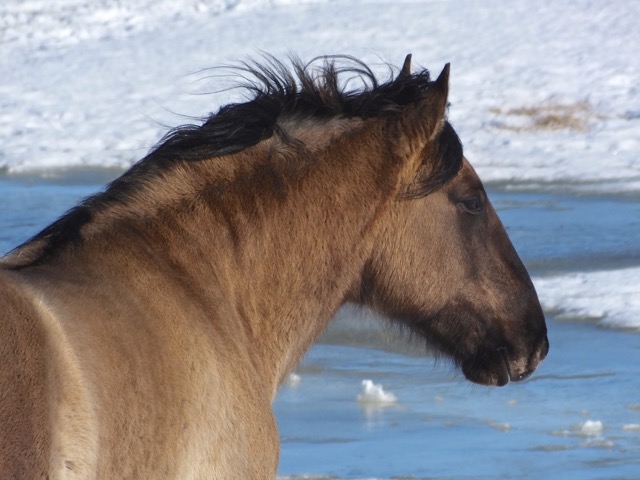
Silvestre, soaking up the February sun at Ravenseyrie,
soon he will be shedding his warm, winter coat and I will spin
more yarn from him and his mates!

I titled that entry Spinning Sorraia!...double click on the title and the magic of the internet will take you to that particular creative odyssey.  

In this month's journal entry, I would like to share with you what I was inspired to create with the horse hair my friend Annemiek sent me from the Netherlands.  


Rudolf, a dark bay Thoroughbred and good friend of my friend,  Annemiek Stuart
photo credit:  Jacolien Frens

Annemiek's horse, Rudolf, and the Furminator brush she used to collect his shed winter hair

Annemiek sent a nicely prepared bagful of Rudolf's dark bay hair, scented with earthy essential oils.  For a horse-loving-gal such as me, the mingling of Miek's essential oil scents with the natural odeur de cheval had me intoxicated with the desire to card and spin a sample of Rudolf straightaway.   


Annemiek's bag filled with horse hair from Rudolf
alongside my first hand-carded rolag
75% horse hair/25% sheep wool

My first spin of Rudolf's hair I did on a homemade spindle

I asked Miek if she wanted me to spin yarn and send her the finished skeins for her to use, or would she like me to crochet something special?  Annemiek opted to have me make something for her.

During the period of several weeks that I was carding and spinning Rudolf's hair, I was all the while thinking about what I might crochet for Miek.  I was surprised that Rudolf's hair was a bit more prickly than the hair of our "wild" Sorraia horses - I would have expected it to be softer than the grullo hair.  I decided to try blending Rudolf's hair a bit differently and went with 60% horse hair to 40% sheep wool and that helped make the yarn spin more even, but I felt it was still to prickly for making a garment like a hat or a neck warmer.  Perhaps a vest might be nice?  Hmmm...

...reaching into the tote bag Miek had sent Rudolf's shed winter hair in gave me the idea that the yarn made with Rudolf's hair would perhaps make a very unique and useful fashion bag.

Being still fairly new to crocheting (since October 2014), I had never before made a tote bag and began to research images and patterns until I felt I could cobble together something of my own design.  It soon became obvious that there was not a sufficient amount of Rudolf's hair to make enough yarn for the size of bag I had designed, so I decided it would be a great time to use yarn that I had made from thistledown gathered off the Ravenseyrie landscape.

Bull Thistle (Cirsium vulgare) at Ravenseyrie

I don't have my own photo handy of the cottony down the Bull Thistle yields up when it turns to seed, but you can view a nice image of that at Andy's Northern Ontario Wildflower website.

Handspun yarn made with Thistle Down
50% sheep wool/50% thistle down
I was a very bad girl and did not back up photos taken on my iPad of what carded thistledown looks like and those images have vanished.  (I promise to document more thoroughly how I make yarn from thistledown this autumn!)  Even more appalling - I did not keep track of how I made the tote bag, i.e. what size hook, what combination of stitches, how many, etc.  Definitely Miek's fashion tote is a one of a kind as I doubt I could reproduce it even if I did have more of Rudolf's hair to make yarn from.

Fashion tote bag made from horse hair and
thistledown yarn
I was very happy with how the tote bag turned out.  It was a great educative experience for me to learn to increase and decrease stitches in particular places so that I could get a rather flat, rectangular bottom.  I was very pleased with the addition of the thistledown yarn, as it had lots of rustic nubbiness and subtle brown flecks from bits of chaff from the dried plant matter that complemented nicely with the dark bay colour of Rudolf's shed winter hair.  I used sturdy jute to make the handles.

I decided that this tote bag would be more finished and useful if I made a liner for it - another new aspect of learning for a gal like me who can hardly sew a button back on correctly.  Thankfully, Lynda Noe, an expert quilter/fibre artist has her studio on the lower level of the building where my Ravenseyrie Studio & Art Gallery is located.  Back in 2010, Lynda and I had a joint exhibition at the Gore Bay Museum's art gallery.  You can read about that show by clicking HERE. With Lynda's input, I was able to make a nice liner for the tote bag that would keep things from poking through the spaces between the crocheted stitches.

Horse hair fashion tote, with liner sewed in
Yes, indeed...I felt this was a very nice fashion tote and perhaps the only one made from horsehair yarn!  I packed it up and sent it off to the Netherlands in early November, anxious to see if Miek liked what I made for her with Rudolf's hair.

When Annemiek received her package from Canada, she wrote me that she thought making a tote bag with Rudolf yarn was a great idea and sent me a photo of it as soon as she unwrapped it:

Horsehair fashion tote, safely makes it to its destination in Holland
Later, Miek sent me photos of when she showed Rudolf the tote bag.  She said she thought he liked it but he seemed more curious about the way it smelled than how it looked.  (I wash my finished yarn and completed crochet items in water containing lavender oil to deter bugs from making a meal of the fibres.)


Annemiek Stuart with Rudolf, who is checking
out a fashion tote made from his shed winter hair
Annemiek gives Rudolf a kiss of thanks for his contribution
to her wardrobe 

I had a great time spinning horse hair again and crocheting it into a tote bag along with homespun thistledown yarn and really appreciated getting a feeling for the differences between Rudolf's hair and the hair of our Sorraias.  All the Sorraia yarn that I made from last winter's shed winter coats I am saving and hoping to add more to it this spring when all those lovely wild equines shed once again.  I have an idea for a dressy poncho I'd like to make from those varied shades of grey.

Horsehair yarn from grulla coloured Sorraias
naturally shed winter undercoats


Thank you Annemiek for gathering and sending me Rudolf's hair, and also sending photos to help me document the process here in the Journal of Ravenseyrie.  I hope you get many years of good use out of your Rudolf fashion tote!  And for those of you who wonder what to do with all that hair that comes off your horses in the spring...you might consider taking up spinning!  This author thinks horse hair makes wonderfully attractive and useful yarn!
  

Wednesday, January 13, 2016

Sensuous Touch of Wind and Sky


Sorraia stallions in the snow at Ravenseyrie


Let REAL life seduce you...
Embrace the sensuous touch
of wind and sky.  --L. Gerard

Come with me today, won't you?  I want to show you some scenes from the past few days here at the Ravenseyrie Sorraia Mustang Preserve on Manitoulin Island, Ontario, Canada.

Sunday was turbulent, with a good "snow and blow" - the first robust winter storm we've had so far this season.  When those bitter winds howl over the East Bluff, and especially if they are accompanied by heavy snowfall, the "wild" horses of Ravenseyrie seek out the forested areas and woodland copses that provide shelter from the elements.

Depending on which direction the storm is blowing in from determines which sector of the preserve the horses will take refuge in.  Since they are limited to just 360 acres and winters are long affairs here on the island we provide mixed grass hay twice daily.  The horses know that Kevin and I will be bringing out toboggan loads of "dried summertime" to supplement their daily foraging and they keep watch as they wait for us to cross through the open wind and enter into their more subdued wooded copse.  Kevin and I call those treks with the toboggans, "mushing".  Kev says, "Today we mush to the north copse!"  And with him breaking trail, this old gal can enjoy the labour of it.

Both morning and late day feedings of hay were mushed to this favourite windbreak on that stormy Sunday.  Funny thing about the island...often the weather we are having up on the bluff in Gore Bay is different than what the more central and southerly realms like Tehkummah (where we keep our Sorraia mares on the Twinravens range) receive.  Mark let me know that they were not being "walloped" by the storm down there at Twinravens as we were.  Ain't that something?   


Kevin Droski delivers hay to the wild horses of Ravenseyrie

Sorraia stallion, Altamiro

These next photos are from yesterday morning.  Another "snow and blow" had moved in just after the Ravenseyrie bachelors had finished their morning feeding, which we were able to lay out for them nearer the house.  Off they went, bent into the wind, heading for the forest and some shelter from the elements.  And likely the mares down there in Tehkummah were dining on the large round bales I left for them in their forest shelter, as Mark let me know Twinravens was not spared this time and were getting in on the "snow and blow", too. 

A tight foursome of Sorraias heading for shelter


Last to head for the forest are Zeus (a domestic Thoroughbred gelding) and
young Sorraia stallion, Destemido 


Now this morning.  It was -24ºC when we went out to feed the bachelors.  That's the chilliest we've been so far this winter.  But...oh bliss!...no wind.!  Not even a puff of a breeze!  A pristine morning, and the frosty fellas were waiting near the house.  The colours were emerging so engagingly, I decided to hang out with the bachelors and wait for the sun to work some magic.

Looking north, waiting for the sun to enhance the colours

Sunrise at Ravenseyrie

Your author, laying in the snow, enjoying the horses and the big sky


Altamiro has an interesting drip line of frozen moisture

The Lone Spruce waits for the sun's touch, too.

Colours are getting stronger

Is Altamiro watching the sun's emergence, just as the Spruce and I are?


Legado (aka "The Pistol") watches me watching him

The sun has to climb above these clouds before it casts is glow on the horses


Ravens are flying over...I wish they would come closer!

And the glow begins to reach the horses, just a wee bit

The slant of winter sunlight...still subtle, but ever magical

That was all I got out of that first crest of sunlight as more clouds obscured it again.  It was time to go to the house and warm my feet by the fire.  And wouldn't you know, once I was back inside...the sun broke through the clouds again and gave me the better contrast of light I had been hoping for.  Just look at the colours!  How spectacular that sky drama would have looked with me aiming my camera lens at a Sorraia while I was laying in the snow.  It still looks spectacular from my open door, even so.

Lake effect clouds over the North Channel

Lake effect clouds over the North Channel push deeper over the bluff
I could have stayed poised with my camera all day long, taking photos of the sun and clouds waltzing so seductively...but I have a business to run...and I had to get meself down the bluff to open the gallery.

Once down there...I was rewarded with this view off the balcony outside my studio.  Now you get to see those lake effect clouds over the North Channel before they push up the bluff.  And up on that bluff...wild horses roam.  Isn't life wonderful?

Lake effect clouds over the North Channel, pushing up the East Bluff,
as freeze up begins in the winter of 2015/16
Gore Bay, Ontario


 "The human body is not a closed or static object, but an open, unfinished entity utterly entwined with the soils, waters, and winds that move through it--a wild creature whose life is contingent upon multiple other lives that surround it, and the shifting flows that surge through it."  -David Abram


Thursday, December 31, 2015

Blanding's Turtle / She in the Moonlight


"She in the Moonlight"
Original Watercolour by Lynne Gerard


"Why haven't you used your gift certificate in the gallery yet?", I inquired.  "It has been a year or more by now, hasn't it?"

"I'm saving it for just the right thing", she replied.

"What might that be?  Can you give me any hints?", I asked.

After a thoughtful pause, she said, "A Blanding's Turtle...in any medium - whether a rock painting, ink wash sketch, or watercolour.  Whatever happens to inspire you."

And who could not be inspired by a face such as this?:


Blanding's Turtle
photo: Ontley McNauth via Wikimedia Commons


I should not have been surprised at her suggestion - I remember her telling me she has been passionate about herpetology since a very young age.  Knowing, also, of the peculiar plight the Blanding's Turtle has been experiencing these past several years on Manitoulin Island, I might have guessed the image of this endangered turtle was something she was hoping to show up in my work one day.

Blanding's Turtle (Emydoidea blandingii)
photo: Andrew C. via Wikimedia Commons


The Blanding's Turtles that inhabit Manitoulin Island, specifically those that dwell in the Misery Bay Provincial Park have suffered unexplained casualties.  Several articles have been written about these strange deaths, for example here and here and here. (clicking on the word "here" will take you to the articles)

I had taken some photos of a female Blanding's Turtle that had been attempting to make herself a place to lay eggs on the shoulder of Scotland Road, just to the east of our driveway.  But, unfortunately I took those on my iPad and they no longer are there.  I thought I had taken others with my regular camera, but after consulting my iPhoto library, all I could find were those of a good looking Snapper Turtle that had been cooling itself in a puddle in our driveway:

What an inspiring profile!

What a penetrating gaze!

What a spectacular turtle!


Well, seeing those images I took of the visiting Snapper, I've definitely got to make a painting of that turtle in the near future!  But, I digress...

Back to this particular tale of the Blanding's Turtle.

Working from a myriad of images in books and online resources, I finally came up with a pose for my Blanding's Turtle, which I envisioned with a simple backdrop of the beach and lake.  I did a charcoal sketch to see if what I had in mind would make a decent enough composition:


Charcoal study of Blanding's Turtle
I did indeed think that would make a nice painting, but as it was the middle of tourist season at that time and the gallery was too busy for me to feel confident getting into a watercolour painting, I put the project aside until just two weeks ago.

Since November I had been thinking I should get on with making a watercolour of the turtle, but found myself painting some other subjects first and cutting mats for some of my prints to restock the print bin in the gallery.

Hand-Calligraphed verse and fine art print by Lynne Gerard


While lettering the mat for one of my fine art prints that has a fabulous moonlight theme to it, I got the idea in my head that our Blanding's Turtle would look equally fabulous in moonglow.  Instantly inspired, I quickly worked up a small watercolour sketch of the Blanding's turtle, and included a moon  (and evocative moonlight) over the water:

Small watercolour study of a Blanding's Turtle

This use of the magical effect of nocturne light was also inspired by one of Mark Seabrook's  paintings (who I wrote about in the Journal of Ravenseyrie earlier this month).  Mark gave me a painting he did of his cat, Percy, because I was captivated by the colours and how it reminded me of our own cat, The Black Pearl.  I have framed it and have it sitting now on an easel in my studio, precisely because of how otherworldly the colours are:


Our feline friend, The Black Pearl, admiring a painting by
Mark Seabrook


I thought some of the chartreuse green colour would make for good contrast and effect in my painting, too, and would work well overall with the other greens and blues.

detail of moonlit greens

detail of the watercolour, "She in the Moonlight"

When I showed my husband the painting, he referred to the turtle as a "she".  I had been thinking of it as a male, but Kevin said he definitely had a good feeling of a female when he viewed it.  Without seeing her underbelly or knowing the length of her shell, we cannot really say if she is really a she or a he, but I'm trusting Kevin's instinct.  And so the title I settled upon became "She in the Moonlight".


Finished watercolour and calligraphy by Lynne Gerard
overall dimensions 22" x 26" 


"In the cool hush of eveningtide, moonglow speaks directly to the heart."  -L. Gerard

And will this painting speak directly to "her" heart, she who requested seeing this particular turtle show up in my work?  I will know soon, as I am sending her a link to this blog entry to notify her I have finally painted a Blanding's Turtle.