Showing posts with label PZP. Show all posts

Saturday, December 7, 2013

Life is Not a Machine


The Sorraia Mustang Mares of Ravenseyrie on the Twinravens range, Tehkummah, Manitoulin Island, Ontario


Manitoulin Island has kissed goodbye the embrace of a long and glorious Autumn and turned its face to receive the quickening freshness of Winter full on the brow.  After a slight resistance, (missing the feeling of the easy step out of the screen door, free from the burden of layers of clothing) I smoothly roll into the sensations that come with frigid temperatures, early nightfall, treacherous roads and the extra work heavy snow brings.   It doesn't take long for me to remember that when appropriately outfitted - mentally and physically - I am Winter's Lover. 

Having my studio and art gallery closed now on not just Monday, but Sunday as well provides me the option to make my weekly visit to Twinravens to visit with our Ravenseyrie Sorraia Mustang mares on which ever day provides the better weather for the hour's drive to the more southerly sector of the island.

Sunday, November the 24th, dawned clear and sunny with a thermometer reading of -12°C, and very little wind...this after we had rain followed by our first bona fide "snow and blow" on Saturday.  With the roads ploughed and in pretty good condition, Kevin wanted to use this window of opportunity to employ his Kubota tractor's front end loader and sink another huge round bale of dried summer into the back of our old pickup truck allowing us to add to our larder of feed to support the winter forage the Twinravens range provides the virtually wild mares.  I made us some avocado sandwiches and hot tea and we were soon on our way.

Once we reached Twinravens, we went right to the back sector to (groan and grunt and...) roll the bale of hay off the truck and into the more protected area of the range, near where we had run a fence line into the forest to offer the mares shelter from the elements when they so desired.  Then we drove into Mark and Michelle's yard (the lovely couple who provides their wilderness range for the mares' use) and put together portions of whole oats and alfalfa cubes to offer the mares a nutritious treat.  

The mares coming up for treats on a fresh, frozen morning

The mares were keeping off toward the back-centre of their range and rather than expect them to come all the way up, we carried their buckets of treats out to the upper flat region where they used to like to congregate during the summer.  From there I put out my call to them.  Of course Bella (who has assumed the leadership role) had already seen us coming and was trotting our way with her head held high for better vision and with nostrils widely dilated, scented the air to gain feedback on who we were and what our intentions might be.  It didn't take her long to recognize it was her friends, Kevin and Lynne so she moved into a canter with the mares now close on her heels, all knowing a feeding of treats was being offered.  Belina was uncharacteristically coming in lastly, and as she came closer in view we could see why:  Belina had a foal running alongside her!

We were stunned!  

We were elated!

We were also dreadfully concerned...a foal born at the beginning of a Northern Ontario winter is most unusual, and potentially deadly.  

Elation won over, for there she was...this perfect filly dancing over the landscape looking as astonished as we humans!


A perfect new Sorraia filly!


In the spring of 2012, still believing we could provide an autonomous living experience for a family band of wild horses, but recognizing that the offspring were approaching a number the limited available range could not ideally support, we enrolled in the unique fertility control program established by the Science and Conservation Center of Zoo Montana, which was reported to work so well for wild mustang herds in the United States.  

Along with the other Ravenseyrie mares and of-age fillies, Belina received the primer dose, and follow-up booster of PZP which we were confident had been effective in preventing pregnancy as throughout the rest of that year she did not show any signs of carrying a foal, nor did she deliver one in the spring of 2013.  

Photo credit:  Kevin Droski

At the time when we would have been called upon to extend the fertility coverage with an annual booster shot delivered by remote dart, it became apparent with so many young stallions soon to "come of age", the Ravenseyrie preserve could not provide the physical or the mental space for more than one stallion when mares continued to be among them.  The acceleration of aggression among herd dynamics and our discomfort with certain aspects of the PZP fertility control program provoked our decision to separate the sexes.  The females were relocated to the Twinravens range in the spring of this year.  

Belina and her three day old filly and the Twinravens canine, Akina
photo by Kevin Droski

Belina has always been an "easy-keeper" tending towards obesity.    After looking almost slender when first moved to Twinravens I had noted she looked particularly "robust" on my last two visits.  Of course I did remark to Kevin and to Michelle that Belina looked like she could be pregnant, but she did not act the part, and knowing she had been on fertility control for a full year and removed from Altamiro's presence before breeding took place during the 2013 season, it was easy to assume she had simply put on good weight during the summer and autumn on the ample grazing and foraging available at Twinravens.

Photo credit:  Kevin Droski

To deliver a foal at the end of November meant that Altamiro had managed to get Belina pregnant in December of 2012...well out of the usual estrus season for wild living horses in Canada!  Checking in with my calendar, where I chart observances of the activities of the horses, the last heat cycle and breeding by Altamiro I noted were in June of 2012.  Whatever type of off-season estrus Belina experienced, it was much more subtle than what is typical for her and went undetected by me, but obviously was taken advantage of by the amazing Altamiro.

When I sent in my report to the Science and Conservation Centre letting them know that one of our mares failed to receive the full year of protection against pregnancy resulting in an out-of-season birth, I received a reply from Dr. Jay Kirkpatrick, one of the creators of the PZP immune-contraceptive.  I asked Dr. Kirkpatrick if I could quote his response here in the Journal of Ravenseyrie, but have received no follow up reply, so I will synopsis his thoughts on this situation with Belina instead.  

Photo credit:  Kevin Droski

Dr. Kirkpatrick pointed out that out-of-season pregnancies have been observed in North American wild horses even among mares that had not been treated with the immuno-contraceptive, however it is not something that occurs frequently and therefore they do not worry about it.  According to Dr. Kirkpatrick, wild horses that are left to themselves develop compressed breeding seasons in response to the "function of light (photoperiod)" but that there also is a genetic component that is carried forward because foals that are born out of season do not have the same chances of survival that in season foals receive.  Human intervention that supports out of season births therefore creates a genetic trait that extends estrus periods.  It was then suggested if "out of season estrus and ovulation is common" among the Ravenseyrie mares, we should provide "a booster in the fall as well as the spring."  Being a busy man, I'm sure it slipped Dr. Kirkpatrick's memory that I had already informed him  we had separated the mares in the spring and no extra boosters of PZP were needed as we had opted out of the program.

Photo credit:  Kevin Droski

While I appreciate the work Dr. Kirkpatrick and his associates are doing to alleviate the deplorable manmade crisis among the free range North American Mustang horses in the United States, I did not find his response to the situation with our Ravenseyrie mares adequate.  I sent a reply to Dr. Kirkpatrick alerting him to the fact that while what he had relayed may be true for some horses, it was not necessarily true for our horses.  In the case of Belina, all five of her prior foals had been conceived in the spring and delivered in the spring.  The only difference for her in 2012 was that she had been dosed with the immuno-contraceptive, which successfully prevented pregnancy during the usual spring/summer estrus cycles, but failed to carry that protection for the full year.  Had she not been given the immuno-contraceptive, Altamiro would have settled her in the normal breeding period the Ravenseyrie group had established for themselves.  Prior to our participation in the fertility control program, our mares conceived and delivered foals between the months of March and September.  

To my knowledge, the female predecessors in Belina's lineage were all free range wild horses roaming public lands in Washington state, more likely suffering from persecution by humans than supportive efforts that aimed at extending breeding seasons.  If Belina's unseasonal estrus cycle has a human stimulus, it is more likely the PZP's interference and not an inherited genetic component.   I feel it is important for those involved with the PZP fertility control to have the information of how its use played out in the events with Belina.

One week old and doing fabulously well!

That "business" finished, let me take readers back to the situation with Belina and her excellently made filly...

Mark does a head count of the mares each morning through field glasses and relayed that there were not eight horses when he did his check that day.  While the new filly had a dry coat, was steady on her legs and well aware of where to find a warm meal, Belina had frozen blood still clinging to her rear legs.  Michelle reported that the dogs had been out in the field most of the morning...she thought they were playing with the horses (something they do frequently).  Later I saw Nishin pulling on the afterbirth off in a different sector of the range.  It soon became apparent that Belina must have delivered this filly just a handful of hours before Kevin and I arrived.  Marvel of marvels!   How cool is that!?  Belina (whom we affectionally call "Popo") happened to pick a day to deliver her baby that was not only bright with hope, but synchronistically also one that Kevin and I would be coming to visit with her and her herd mates!


With Mark and Michelle stepping in and going out to the field (often twice a day) in the first week to check on the status of that new filly for me, my worries that the wintry weather might prove too much for her to cope with melted away.  Each report Michelle and Mark emailed to me relayed observations that were all completely normal and made it easier for me to be at work when all I really wanted to do was be around that filly and make sure that her environment, her mother and her aunt and cousins would be able to support her as she adjusted to life out of the womb at a less than optimum time of year for newborn foals.  


The Sorraia and Sorraia Mustang horses are amazingly capable survivors!  And why wouldn't they be?  Their inheritance are genetics and instincts that developed in wilderness environments and has (obviously as demonstrated here in Canada) not been weakened by whatever influence mankind has imposed upon them over the centuries.    

Sorraia stallion Altamiro on a frosty winter's morning at Ravenseyrie


Kevin went down to Twinravens midweek to make some fencing adjustments and check in on the newbie, taking photos as well to share with me when he got back home.

When I got to see the mares and new filly myself the following Sunday, I was delighted with how the thick winter coat she was born with appeared even more serviceable than the week before, as if it had grown more lush now that mother's milk and physical activity were daily features of life, as opposed to being folded up in an amniotic cloister.


While your author gives Belina a rump itch, Belina does the same for her filly.photo credit:  Kevin Droski

photo credit:  Kevin Droski

Kevin and I will be heading down to Twinravens tomorrow morning and I am looking forward to perhaps trying out a few potential names on the new filly to see if she finds one acceptable.  

As for the bachelors here at Ravenseyrie...you can see they have adjusted seamlessly to the ways of winter.  And take note how much more snow the East Bluff had during that week than what Mark and Michelle experienced an hour's drive south of us at Tehkummah on our fair island of Manitoulin.


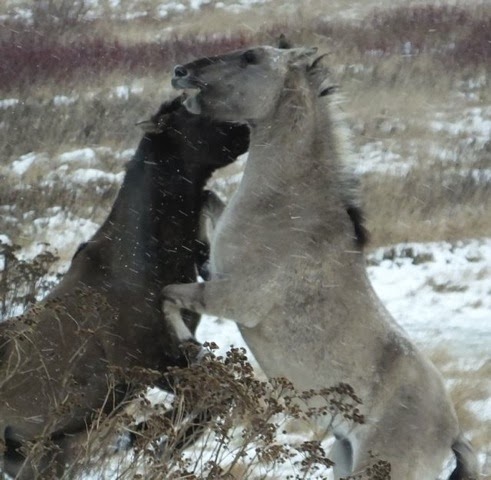
Young Sorraia stallions Destemido and Legado playing boy games at
the Ravenseyrie Sorraia Mustang Preserve


Young Sorraia stallion, Fidalgo at Ravenseyrie

Late day hay at Ravenseyrie


Our smart new filly gets extra warmth in such a position as this!


So it seems fate has determined that there should be two foals born from Altamiro and his mares in the year 2013.  Just looking at the way the year types out:  2013...so futuristic in appearance...and a time when we humans are ever increasing our attempts to manipulate Nature to suit our purposes...it gives one pause to admire that we actually do not control everything..."life itself is not a machine".  There are processes and urgings that manage to find their way around our belief that we are the superior life forms.  This filly's surprise presence among us has me exploring how I can be less manipulative and more cooperative with the natural dance of the five elements that make all we see in this world possible.


"It becomes ever more obvious that the Earth and life itself is not a machine, a steam engine or a computer; that competition is not the primary ordering principle in Nature, and that co-operation is a far more stable and successful solution."  --Adele Getty from the book, GODDESS / Mother of Living Nature


Saturday, March 17, 2012

PZP, Castration and Horse/Human Relationships


Members of "The Tribe" frolic on a snowy day in February at the Ravenseyrie Sorraia Mustang Preserve


In one brisk movement Dr. Lazier took the severed testicle and flung it well away from where Interessado lay groaning. I quickly ran over to recover it from the mud and did the same when the second gonad made a similar journey. I set these aside for a proper, more respectful disposal. Soon Dr. Lazier and Kevin were helping Interessado remain steady on his feet. It was over. I had my first witness of field castration surgery and found it is not something for the faint of heart!

We had one more colt to do. The raw November day was quick to grow dim as we waited for the sedative injection to take effect on Silvestre so he would allow Dr. Lazier to inject him with the anesthetic. It did not. Silvestre's surgery was cancelled and rescheduled for the next day.

Interessado (3 yrs. old) gets drowsy from the initial sedative, administered by Kevin via a dart pistol.


The following day was just as cold and dim as the day before, and once again mild-mannered Silvestre did not respond to the drugs in the typical manner most horses do.  It took a triple dose of both drugs (Xylazine and Ketamine) to bring the two year old Sorraia Mustang down and even that proved insufficient as he violently erupted to his feet just after the first testicle was emasculated. Dr. Lazier injected more anesthesia and somehow amidst frigid winds, icy mud and an equine mind twisted by synthetic chemicals the surgery was completed.

I had placed Silvestre's testes atop the nearby manure heap to retrieve when all was finished. While still heavily compromised by the effects of the drugs, Silvestre stumbled and staggered his way over to the eight foot mound and tried to climb it, which was a strange and unsettling end to his life as a young stallion.


Silvestre (2 years old), the day after his castration surgery...in pain and depressed


Then there were weeks of monitoring leaking fluids and swollen sheaths. My vet did not tell me about the potential for dreadful and dire complications. Aren't we all under the impression castration of horses is a simple, routine procedure that does not impact the animal all that much (with the exception of ending his ability to reproduce and altering his behaviour)?


The beach at Ravenseyrie:  the perfect setting to contemplate weighty decisions involving the equines who live here.


The reality is that 20% of equine castrations result in one or more complications that impede healing--or worse, claim the life of the horse. This form of equine contraceptive has been routine for thousands of years and even during modern times, with the application of sedatives, tranquilizers, anesthetics, etc., it is not benign--not one bit.

For us, it was the first time we had deliberately caused these horses harm. They were healthy, robust young lads and we purposefully had them wounded and put them in a potentially life threatening situation. It gave us pause... These castrations became for us just one more unpleasant aspect of participating in and managing a preserve for a type of endangered wild equine where breeding is allowed to take place.


Full brothers:  Interessado and Silvestre, healed and in good form after being gelded in November of 2011


In the six years that Kevin and I have devoted our lives to saving the Sorraia, we have experienced unparalleled joys. Making it possible for these inspirational equines to live a mostly autonomous existence has further altered our philosophical views on horse/human relations as we observe and participate in their rich, interesting culture. We find ourselves now, more than ever before, reluctant to introduce leather straps of control over these beings. We find the process of selling (donating wouldn't make it any different for us) the offspring riddled with unpleasant tasks to ready them for a life elsewhere and rife with sentimental hardships. Never having experienced this before, we could not forsee how changed we would become and how unfit it now makes us for managing a breeding preserve.


 Altamiro


These same elements that have convinced us we are not, after all, the type of individuals who should be breeding and selling horses also has us unwilling to end it by dispersing the herd, or separating Altamiro from his mares by forcing them apart with fencing. Gelding Altamiro would, in one swift action, settle the matter...But you do not castrate the only purebred Sorraia stallion in Canada. (Who also is one of just two purebred Sorraia stallions in all of North America.) Another form of equine contraception was sought and after researching the options as thoroughly as possible, we found oursleves--once again--determining PZP to be the most effective, least invasive, lowest risk alternative to castration or separation.  Its use on wild horses has been closely monitored by scientists for over twenty-two years and last month PZP received its official registration status by the Environmental Protection Agency through the sponsorship of the Humane Society of the United States.


Altamiro with his son, Interessado the day after Interessado was castrated


Not everyone agrees. of course, that the PZP equine contaceptive is the appropriate choice, and two breeders involved with the Sorraia preservation have asked how Kevin and I could make this decision--since it is definite manipulation of the herd and not completely free of risks. Specifically, these concerns have been raised:

--In some studies it has disrupted herd dynamics and grazing habits

--It has the potential to induce auto-immune disease

--It can render the mares permanently infertile

--Stallions will be stressed by the continual breeding and defending of mares in heat


Levada


Tocara


These concerns are addressed in a question and answer document titled:

Immunocontraceptive Reproductive ControlUtilizing Porcine Zona Pellucida (PZP)in Federal Wild Horse Populations

 (Double click the above title to read the document.)

At the end of the document is a bibliography of research articles (nine pages long!) which are helpful if one wants to read further about any of the issues concerning PZP.   After reading the Q&A and accessing many of the articles referenced, Kevin and I overcame our reservations, realizing that the potential risks are miniscule when compared to the detrimental elements inherent in castration as well as other contraceptives in current use on either stallions or mares.  To my way of thinking, PZP's potential for harm to the mares is far less than the potential harm caused by traditional stabling, equestrian sports, artificial insemination and pregnancy itself.

Unless humans are willing to take down the fences in wilderness areas and let horses live their lives apart from us, we will in one form or another be impacting their natural proclivities and find ourselves faced with making decisions that alter their way of being.  Each of us who love and live with horses seek the decisions based on our individual situations.  What we have decided to do here at Ravenseyrie might not be the answer for someone else in a similar situation.  We may find in the future it wasn't right for us either...but we had to make a choice--our land and finances are limited, and we have, as mentioned before, a certain philosophy of horse/human relationships that underscores these decisions profoundly.


Silvestre receives a rebuff rather than a welcome from Levada during his first attempts to reintegrate with the non-breeding group, a collective of Altamiro's offspring we refer to as The Tribe.


Additional Information:

On April 12th, I received an email from Dr. Jay Kirkpatrick, the developer of the PZP immunocontraceptive vaccine, which I reproduce here with his permission to further dispel the real and the imagined apprehension regarding potential risks of using this vaccine as fertility control among wild horses: 

Dear Ms. Gerard,

Kim recently passed your blog on to me and I found it encouraging and fascinating.  I applaud your efforts and we are delighted to be able to help you. 

As I read through the journal I came upon the section that listed the concerns/risks associated with the use of PZP in horses, and I thought I might add to what you already know.  I do this to help you educate those who still have concerns.


--In some studies it has disrupted herd dynamics and grazing habits

The studies most recently cited as "disrupting" herd dynamics have all come from Cape Lookout National Seashore horses (Shakleford Banks).  What the studies do not tell you is that the "controls" are a group of nine mares that are never treated and which get pregnant on a regular basis and then have their foals taken from them.  These mares, as a result of their constant state of pregnancy and loss of offspring, are not in as good condition as those treated and without foals.  One could conclude from this study that mares not treated and permitted to get pregnant on a regular basis and then have their young taken from them tend to stay within their band more often than those who get treated and do move more frequently.  The point is, that these studies have not used legitimate controls.  In contrast, 24 years of management of the Assateague Island horses with PZP has not resulted in any difference in movement between bands by treated or non-treated mares.  The primary difference between these Assateague mares and the Cape Lookout mares is that the former are not chased allover the island with ATVs and then have their foals forcibly removed.  Nor was the Cape Lookout study controlled for age of band stallion, which is the single largest determiner of mare band fidelity (the older the stallion, the more fidelity).  There are several other factors that are associated with the fidelity of mares to the band and none of these were controlled for in that study.  But, no one would know this reading the paper.

There has been a study with western wild horses that shows that the time budgets of treated horses was different from those of untreated horses.  But, the conclusions were that it was the better body condition of the treated mares (as a result of removing the physiological stress of lactation), and the absence of foals, and the significantly greater longevity in treated mares that led to the changes in time budgets.  We need to ask if a human with poor health and condition spends their time the same as one in good condition, or whether a human with a baby spends their time in the same manner as one without a baby, or whether older people spend their time in the same manner as younger folks.  In other words, differences in time budgets simply reflect the results of successful contraception.

In no case, over 24 years of PZP use on wild horses has anyone ever demonstrated that harems fell apart, or that bachelor groups did not form, or that mare hierarchy changed or that any of the fundamental evolutionary-driven social structure/behaviors have changed.

--It has the potential to induce auto-immune disease


Perhaps that potential is there, but 24 years of use on horses has not resulted in this.  The literature, as you point out in your blog, reflects the following changes:  better body condition, decreased foal mortality, significantly greater longevity.  Autoimmune disease would not be associated with better health! 

--It can render the mares permanently infertile


We first published extensive reversibility data in 2002.  Basically it showed that a mare treated for three consecutive years would reverse in a mean time of about 4 years.  However, the range is 1-9. Thus, some mares will take much longer than others, and some will reverse really fast.  That is no different than humans and flu vaccine.  We are at the mercy of the target animal's immune system regardless of the vaccine.  Some will turn out to be poor responders and not become infertile at all - fortunately very few.  Some will respond very strongly and take much longer to return to fertility, and there is the possibility that a very small number - only a few - out of hundreds and hundreds - might never return to fertility.  Fortunately there is a norm for immune responses and most mares will fall within that norm.  We do have data that shows that mares treated for seven consecutive years probably will not reverse, but if you are treating a mare for that long, you probably don't want her to breed again anyway.  This all brings to focus the importance of your management plan.  Any contraceptive is no better than the plan under which it is put to work.  Much of this concern comes from quarters who focus only on the exception rather than the general.

--Stallions will be stressed by the continual breeding and defending of mares in heat


This is categorically false and there is no data whatsoever to support it.  First, horses are seasonal breeders and they seldom cycle (with ovulation) outside the seasonal breeding season, whether they are treated or not.  Second, the further north the herd, the more sharply defined the breeding season - and you are north!  Third, mares have what we refer to as transitional seasons - in the fall and spring.  That is, they start to ripen a wave of follicles (eggs) and the production of estrogens are associated with this phenomenon.  This causes estrous behavior, but ovulation does not occur.  So, often we see mares demonstrating estrous behavior outside of the breeding season, but this is not an ovulatory cycle and it occurs in non-treated mares - in the spring and in the  fall.  Once again, over 24 years we have not had any stallions fall over, or get thin, or wear themselves out.  The point here, is that there is not a single piece of data to support this idea.  It is someone's "concern" based on pure speculation.  We have gone through the same thing with deer and PZP and perception.  IN deer PZP actually does extend the breeding season (unlike horses) but there are no deleterious effect on bucks. 

Well, these are just a few thoughts, intended to help you.  Keep up the good work.

Jay

Jay F. Kirkpatrick, Ph.D.
Director
The Science and Conservation Center
2100 S. Shiloh Road
Billings, MT  59106
(406) 652-9718

I'd also like to take this opportunity to direct readers to the website of the Science and Conservation Center, specifically to their page embedded with educative videos--the lower video is especially illuminating and I highly recommend you take the time to view it.

In my response to Dr. Kirkpatrick, I wrote: "I tend to be mostly reserved toward science, especially when it too frequently becomes the benchmark of "reality" at the expense of other means of perceiving, measuring and understanding the world in which we live.  But I do recognize there are times when laboratory creations provide something truly helpful in specific situations where our human impact has created an imbalance in nature and we are unwilling, or unable, to withdraw and let nature right things without our manipulation."

I look upon this minimally invasive approach to fertility control Dr. Kirkpatrick has developed to be helpful in situations like our Ravenseyrie preserve and other instances where humans coexist with wildlife and stability of numbers is essential to the holistic health of the environment and all its inhabitants.  It would be a travesty, however, if there were in the future no truly wild places left where horses can live out their lives without human intervention of any kind, as they presently do on Sable Island, here in Canada.  I hope that other regions in the world, where wild horses and human interests are volatile issues, will follow a similar program and allow some wild horse ranges to be equally protected and completely free of human manipulation.


The family band on the Ravenseyrie Sorraia Mustang Preserve in the spring of 2011


Let's get back now to the Ravenseyrie Sorraia Mustang Preserve and issues specific to our situation...

After four years of delivering high quality offspring, of each of our mares has made a significant contribution to the genetic pool of the endangered Sorraia horses, whether this is fully appreciated by the world at large or not. We are looking forward to foals this year from Bella, Belina and Zoriata and if they never have another pregnancy, it is no longer a vital thing--they have left their mark and fully embraced their experiences. Bella, Belina and Zorita (as well as Ciente, who died last year) have always meant more to us than strictly being broodmares anyhow. They can continue to live in virtual freedom in the presence of their stallion and whichever of their offspring destiny shows us need to remain at Ravenseyrie.  The PZP is presently in cold storage and we expect to dose the mares next week.  


Zorita and Belina enjoying their late day hay on a winter's day earlier this month


With Altamiro remaining entire, we retain the option to breed him to an outside Sorraia or Sorraia Mustang mare in the future, if certain aspects fit his present way of life. Once the contraceptives take effect we will no longer be a breeding preserve for the Sorraias, we will nevertheless continue to be safeguarding their genetics and continuing our efforts to raise awareness about the irreplaceable value of these types of horses to the equine species and overall biosphere. Likewise, I will continue to write about the lives of these magnificent horses with whom we share our lives here on Manitoulin Island.


Interessado and Altamiro

While it is a one of my favourite things to develop a relationship with each of the horses who have been born here, it has been painful to find that friendship ending when they leave Ravenseyrie and embark on new futures elsewhere.  Likewise, the time and work involved with an ever increasing number of horses makes deepening the relationships I have all the more difficult.  Both Kevin and I will miss the annual arrival of foals and watching them grow (though PZP is 95% effective, leaving a 5% potential for a surprise now and then), but we look forward to the new opportunities that will manifest themselves once the herd size is stabilized and we no longer have to make decisions about selling, castrating, separating, etc.  I am sure there will be many interesting and inspiring stories to share and on a more frequent basis than time has allowed this past two years.

Update 01April12:

 On Monday, March 26, Bella, Zorita, Belina, Fada and Pinoteia each received their primer dose of the PZP immunocontraceptive and will receive the follow up dose in three weeks.

In the journal entry titled, Gosto Gusto which announced the arrival of our first foal for 2012 Diane Pinney left a comment which more appropriately belongs in this journal entry discussing fertility control, so I have copied and pasted her comment here as well.

"Lynne, words cannot express how saddenned I am by your apparent closing the book on your Sorraia Mustang breeding program there, and no longer being an active participant in a valuable genetic conservation project. You appear to have decided that once you give all your mares the PZP, which I have never supported in any horse herd, that is the end of the story and the horses will only be providing you a visual reward. I would much rather have heard that you were trying to lease out the majority of mares to Sorraia Mustang preservationists, and only keeping one or two so that Altamiro has his own mares still, even if you PZP'd those. If that is something you tried, then I did not get that request to see if I were interested or knew anyone who might have been. Seeing a program that I thought was firmly dedicated to the Sorraia Mustang program being terminated in this way just breaks my heart. I hope that some day you change your mind."

---Posted by Diane at Spanish Sage Ranch to Journal of Ravenseyrie at March 31, 2012 12:10 PM


Diane, I am sorry that the choices Kevin and I have made and the reasons we have shared which led us to the decision to place our mares in the PZP immunocontraceptive program have caused you to feel so distraught.  Let's try and look at the positive elements and see if we cannot give you something to feel good about when you contemplate the shift in our mandate here at the Ravenseyrie Sorraia Mustang Preserve.

Each and every filly and colt that has been sired by Altamiro and born to our mares we have offered up for sale for others who are interested in the preservation of the Sorraia and Sorraia Mustang horses.  Two breeders have taken advantage of these offerings by selecting and purchasing offspring for export to their own preserves. 

Pinoteia, Esperanda and Altavida are three terrific Sorraia x Sorraia Mustang fillies that are still available and each of them surpass their dams in overall Sorraia characteristics.  There remains also the stellar stud prospect of Legado available for preservation minded breeders.  No doubt Bella's 2012 colt, Gosto will also be an exceptional stud prospect and we are still expecting foals from Zorita and Belina for this year, after which the fertility control should mean no foals for 2013.  So you see--we have yet a great offering of these rare genetics for other preservationists to get their hands on, one only has to contact us to begin discussions for purchase!

Leasing is not an option for us* as we do not see these horses as chess pieces to be placed in strategic places, though we can appreciate that from a strict preservationist perspective this is what would be preferred--it isn't something we personally desire to engage in.  Also one must consider that these horses are presently living on a remote island in Canada and anyone who would contemplate a lease would find themselves taking on an expensive undertaking for a simple lease.  Negotiating a purchase, dedicating oneself to these horses long-term and being able to provide them an appropriate habitat (whether five acres or five hundred) that is stable and secure are things we feel are essential.

*With the exception of a possible lease to a secondary preserve here on the island should such an opportunity present itself.

As for our foundation mares--our pact with them has always been that they remain here.  They each have provided a greater contribution to the overall genetics through their offspring from the past five years and we do no disservice to the preservation efforts by placing them on fertility control, which is reversible in most instances.  Those fillies who have not yet been selected for export by new owners will be placed on the immunocontraceptives once they come of age sexually, yet will remain available for purchase with the same considerations for their welfare as before. 

Ravenseyrie has proven that the Sorraia isn't a manmade "breed", but is a primitive "type" whose genetics can be easily consolidated by bringing together a European Sorraia with select mustangs of Sorraia type, thereby helping to alleviate the present bottleneck the Sorraias in Germany and Portugal are experiencing.  One can appreciate the great value these Ravenseyrie offspring have for continuing the conservation of the Sorraia and Sorraia Mustang genetics.  Our contribution carries on like ripples in a pond and ought to inspire other conservation-minded parties to initiate their own preserves.  One can follow the template we have (pairing a European Sorraia with Sorraia Mustangs) or utilizing only North American mustangs of Sorraia type.  Either option will be exponentially advanced by incorporating the available Ravenseyrie offspring--and that, Diane, I hope, is what you will focus on to alleviate your broken heart.


Sunday, March 14, 2010

The Precarious Future of Horses


"Wooo, ooo, oooooo...Wooo, ooo, ooooooo. Oh, a storm is threat'ning..." Metaphorically, I've have recently been hiding under a rock--my head and heart throbbing with the haunting rhythms of the Rolling Stones' anthemic "Gimme Shelter".


In the shadowed shelter of my lichen covered rock, I can process all the confusion and disappointment I feel in so much of the activities of mankind.

Because I feel a special kinship with horses that goes even deeper than the distinct unity I feel for the rest of creation, these days a confluence of darkness has gripped me where they are concerned.

I will share with readers the reasons for my gloomy funk:

Our Ravenseyrie Sorraia Mustang Preserve's efforts to enhance the severely inbred, nearly extinct genetics of the Iberian Sorraia by bringing together a purebred Sorraia stallion and North American mustang mares of Sorraia type, providing them a wilderness habitat where they can live a virtually autonomous life, generating offspring with enhanced genetic variability and rich physical and mental vitality (well balanced bodies and minds) has been an exquisitely beautiful success story--one which many people seem to enjoy reading about. However, as we prepare for this year's foals to arrive, there has not been an overwhelming desire expressed by other people to acquire Altamiro's offspring. In fact we have not sold or adopted out any Sorraia youngsters at all, and so far this year have no prospects presenting themselves. This complicates things in ways we never imagined.


Kevin and are I in agreement that Ravenseyrie should not be chopped up into separate holding paddocks and limited pastures. Putting severe restrictions on our free range horses would be physically and mentally disruptive for them, one could even say it would be cruel to take away such freedoms which are rightfully theirs and to which they have become accustomed. We think Altamiro would go crazy if we put him in a separate pasture where he had to watch the rest of the world (which was once all his) go by. We don't think any one of our horses, whether primitive or domestic, would feel good being kept in a smaller area, unable to participate in the full world of Ravenseyrie. We do think the youngsters who have already been pushed out of the family band would adjust beautifully if moved to a different setting under the right human care.


Altamiro plays with his nearly two year old son, Animado

With segmentation and separation out of the question for us, and with no one interested in negotiating to acquire the youngsters, we further explored the option of administering the PZP contraceptive to the mares in an effort to suspend further pregnancies until we are able to find the best situations for our present fillies and colts. After almost a year of consultation with The Science and Conservation Center at Zoo Montana, we agreed to give the PZP a try. After jumping through the appropriate bureaucratic hoops to obtain the clearance to import this drug into Canada, we were sent confirmation on March 4th that the PZP would be sent to us. Later that same day, a surprising reverse decision was made and we were informed a misunderstanding of our intentions had occurred. It became apparent they had not thoroughly grasped that we would be hoping to sell the offspring and resume breeding when conditions were more favorable, (though our intentions of using PZP only temporarily were clearly expressed in my collective of lengthy correspondence.)

Though I was never presented with any literature that stated the Science and Conservation Center would not provide PZP to organizations which continued to breed and sell horses I have been now been informed that this is against their principles and policy. If we agree to halt breeding altogether and never sell horses, and manage Ravenseyrie as a "sanctuary" rather than a "selective breeding preserve", they will then happily sell us the PZP. Until then, the Ravenseyrie Sorraia Mustang Preserve is considered a "commercial enterprise" so we are told in a letter from Dr. Jay Kirkpatrick, (director of the Science and Conservation Center and creator of the PZP vaccine) Dr. Kirkpatrick also relayed that regardless of our good intentions Kevin and I are participating in the "traffic of horses" during a time when the world is faced with an epidemic of unwanted equines. Could it be that Dr. Kirkpatrick would not feel a pang of sadness should the Sorraia horses eventually disappear all together?

I went into a deeper hiding spot under my rock trying to get over his palpable disapproval of what we are trying to achieve here at Ravenseyrie. In his book "The Four Agreements", don Miguel Ruiz reminds us "Don't take things personally"...at first I failed my prior training and did take Dr. Kirkpatrick's comments as a personal condemnation, but, the magic of the Ravenseyrie rocks helped me eventually suspend such unhelpful thinking.


In truth, I wasn't all that disappointed that we had in the end been denied the use of this equine contraceptive. PZP (porcine zona pellucida) is formulated by manipulating a vaccine out of pig ovaries which when injected into a mare causes an immune system response that inhibits fertilization of her eggs. These pig ovaries are a by-product from a commercial slaughterhouse in Iowa which processes factory farmed pigs for human consumption. I had been considering the PZP a necessary evil that we would use so that we would not have to separate Altamiro from his mares and disrupt their family dynamics in order to temporarily prevent pregnancies. But I never felt it was the right thing to do, to use this type of science and impose it on our mares who would have no choice but to accept our darting them with this drug. The reverse decision handed down by The Science and Conservation Center saved me from once again going against my intuition. I actually feel amazingly relieved!

While Dr. Kirkpatrick and others may feel that selling horses is some form of deplorable, unethical activity, we do not (if the right kind of people can be found), and it remains now our best option--though it is obvious that we may have to find buyers who do not necessarily have an interest in breeding Sorraias or Sorraia Mustangs as a preservation effort.

Herein lies another disquieting element that one ponders gloomily while under a rock shelter: can we find the right people for these wonderful young horses? More and more individuals are coming to look upon horses as companions and friends rather than as livestock slaves or disposable sport tools. More and more people are realizing that horses are happier and healthier when provided a natural lifestyle on varied acreage, rather than being kept in stables and dirt paddocks. How do we find these people? Here we are on an island in northern Canada...are we too far away from the right network of kindly people?


Another huge concern for Kevin and I is how can we be sure that none of Altamiro's offspring are subjected to abusive handling? Abuse comes in pervasive forms, moreso from a wrong perception of horses than ignorance.

A recent flurry of outrage circling online equestrian sites has been brought to my attention demonstrating that "kinder, gentler" training is not necessarily so. While I always had my doubts concerning the perception many popular "Natural Horsemanship" trainers have for horses and how they have crafted their different training techniques in order to serve humans more than to serve the best interests of the horses, I always felt that they were nonetheless more devoted to "making the wrong thing difficult and the right thing easy" and so refrained from methods of painful coercion. I always felt that any rough handling that was done in the name of Natural Horsemanship was due to the misunderstanding of students applying the techniques.

Several excerpts from a Level 1 Parelli training dvd which have been put up on YouTube have opened my eyes that at least one school of Natural Horsemanship uses intimidation, harassment and pain at the foundation level of their training, and it is being taught from the originators themselves. One segment shows a nervous, one-eyed Thoroughbred horse being trained in a manner designed to (in Linda Parelli's statement upholding the value of this technique) "change his dangerous habits and give him the confidence in the leadership of a human."

Another segment shows Mrs. Parelli teaching this same horse's owner how to develop his feel of using the "phase 4 interrupt"--which made me feel just as sick to my stomach as the other excerpt, especially to hear Mrs. Parelli praise her student for getting in a "good clunk" on the horse's lower jaw with that large metal clip on the specially designed Parelli lead line.


Would you want your friend treated this way?

There are better ways to be with horses, and I want to dedicate myself to finding people who are already engaged in better ways or are looking to exchange old concepts for new ones, concepts that see these noble horses as friends and companions...these are the only types of people I want to place the Ravenseyrie youngsters with.

We humans need to stop believing that horses have to be intimidated, dominated and punished in order to be safe to be around! I turned away from this belief years ago and discovered how much better it is to be with horses who have not been coerced into being with me. I, myself, would not treat a criminal the way this horse was being treated at the Parelli training center, and yet people so readily rough up their horses and call it a necessary feature of the horse's education. It's not necessary and its shameful behavior to relate with horses or humans or any entity in this manner.


My head is spinning, thinking about the way we humans treat horses, the environment, each other...and it's not just the present polices coldly and methodically reducing the wild herds of North American mustangs that has contributed to my weeping blue funk--these polices simply reflect a prevailing mindset held by rule makers who don't find value in these horses and so craft bills which turn the hundreds of thousands of acres of public lands over to unsustainable, unethical economic interests buoyed by political croneyism. No, it is also about the overall disservice we humans continue doing to horses, even as we profess to love them. And its about the separatism we uphold between our human selves and the rest of creation. This belief that human consciousness has evolved us into something more advanced than plants and animals has done little to create a well-spring of enlightened behavior--rather such superioristic beliefs have darkened the horizon with hideous demonstrations of violence. It is shameful that "Gimme Shelter" is as valid a wailing against inhumanity in 2010 as it was in 1969. We humans are creatures prone to demented destruction and yet are also are capable of genuine nurturing love, with the balance all askew toward the former. We are a schizophrenic species, which is maybe at least a bit more empathetic a description than Edgar Morin's "homo sapiens demens", but clearly somewhere along the evolutionary process we humans became mentally twisted.

"What we take to be advances in civilization are at the same time advances in barbarism", writes the French philosopher Edgar Morin in his book Homeland Earth. Probably reading this book also contributed to my gloomy funk, for never have I read a more concise accounting of the darkside of humanity. Though Morin describes humans and earth as doomed by the very nature of the cosmos, he prescribes a remedy to make the most of what we have while we have it:

"There is, among the goals mentioned, true, better living, the quest of something in excess of development. The significance of development goes beyond development; for instance, to develop an appreciation of music does not mean that the history of music is a progressive development, that Beethoven is better than Bach or Richard Strauss better than Beethoven. We must acknowledge the limitations of development as a concept, even when defined anthropologically, because the word suggests unfolding, unwinding, spreading. We must relate it dialectically to the idea of envelopment and involution, which brings us back to the origin or preworld, which immerses us in the depths of beingness and reimmerses us in antiquity, which involves reiteration, self-forgetfulness, a quasi foetal immersion in a beautific amniotic bath, a oneness with nature, reentry into myths, an aimless quest, a silent peace." -Edgar Morin


What fantastic dynamics as Animado goes to the older geldings when the game gets too rough!

There are many reasons why the Horse is in crisis and many reasons to believe that the answer is to stop them from breeding in the wild and to stop people from breeding and selling them until such time as the epidemic of unwanted horses subsides. It reminds me of how many women in apocalyptic movies choose to not have children because the future looks to cruel and hopeless. Why would I allow our horses to continue to bring forth young in such a disturbed, schizophrenic human dominated climate? I'll tell you why...because the world needs this type of naturalness, this type of beauty, this type of freedom, this type of non-human intelligence so well represented in not just our endangered primitive horses, but in all horses. Though I don't know what the future holds for us here at Ravenseyrie, I'm inclined to agree with the words of Hölderlin which Edgar Morin quotes in Homeland Earth, "...where danger threatens, that which saves from it also grows."

Awareness is the key, opening up our landscape for more of the wilderness to return is necessary and nurturing our capacity for love and unity and poetic living is essential, and something I hope the Journal of Ravenseyrie can stimulate.


I must go now, and extend an offering to the rocks which give me so much courage to carry on.

"Love, sister...its just a kiss away...its just a kiss away..."

"Eeeyeahyeahyaaah!"